Reference: "Physiological Principles for the Effective Use of Color", G. Murch, IEEE CG&A, pp. 49-54, Nov., 1984.
Introduction
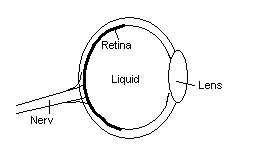
| Color results from the interaction of light with the nervous system. There are several components that affect color perception, including the eye lens, the retina, and a color processing unit along the optic nerve. | |
In the following we will discuss each of these.
| The function of the lens is to focus the incoming light on the retina, which contains the photo receptors. Different wavelengths of light have different focal lengths so, for pure hues, the lens must change its shape so that the light is focused correctly. | 
|
| For a given lens curvature, longer wavelengths have a longer focal length, i.e., red is the longest focal length and blue is the shortest. Since to have an image focused on the retina, the lens curvature must change with wavelength with red light requiring the greatest curvature and blue light the least curvature. This means that if pure blue and pure red hues are intermixed, the lens is constantly changing shape and the eye becomes tired. |  |
A related effect is called chromostereopsis, which is that pure colors located at the same distance from the eye appear to be at different distances, e.g. reds appear closer and blues more distant. Sometimes pure blues focus in front of the retina and so appear unfocused. At night a deep blue sign may appear fuzzy while other colors appear sharp.
The lens also absorbs light, it absorbs about twice as much in the blue region as in the red region. As we age the lens yellows, which means it absorbs more in the shorter wavelengths. So the result is that people are more sensitive to longer wavelengths (yellows and oranges) than they are to shorter wavelengths (cyan to blue) and this increases with age. The fluid between the lens and the retina also absorb light and this increases as we age, so the older people get the less sensitive they are to light in general (the apparent brightness level decreases) and especially the sensitivity to blue decreases.
 Return to beginning
of document
Return to beginning
of document
The retina contains the photo receptors that absorb photons and transmit chemical signals to the brain. There are two types: rods which are night-vision receptors and have no color dependency, and cones, which have color sensitivity and require a higher level of light intensity than the rods.
There are three types of photopigments in the cones; "blue" with a maximum sensitivity at 430 nm, "green" with a maximum sensitivity at 530 nm, and "red" at 560 nm (this wavelength actually corresponds to yellow). Light at a single wavelength will partially activate all three types of cones, e.g. at a wavelength of 470 nm, it will be strong blue plus some red and green component.

| The percentage of cones is not equal but is as follows: blue (4%), green (32%), and red (64%). In addition, the cones are differentially distributed in the retina. The center of the retina has a dense concentration of cones but no rods while the periphery has many rods but few cones. The color distribution is also asymmetrical. The center of the retina is primarily green cones, surrounded by red-yellow cones, with the blue cones being mainly on the periphery. The center of the retina has no blue cones. |  |
We see objects by edge detection, where an edge can be created by a difference in color or brightness or both. Edges formed by color differences alone, with no brightness differences, appear fuzzy and unfocused, so we need to add changes in brightness to get sharp edges.
Photoreceptors adjust their sensitivity to the overall light level, e.g. going into or out of a dark room requires some adjustment time. There is also a required minimum intensity level for the photoreceptors to respond. This minimum varies with wavelength with the highest sensitivity in the center of the spectrum. Therefore, blues and reds must have a higher intensity than greens or yellows in order to be perceived.
Return to beginning of document
From the retina the optic nerve (actually a collection of nerves) goes to the brain but before it reaches the brain there is a color processing unit, called the lateral geniculate body. This recombines the RGB color information into three new channels as follows:
R-G gives red or green color perception
R+G gives the perception of brightness and also yields yellow (Y)
Y-B gives yellow or blue color perception
Thus, blue plays no part in brightness so that colors differing only in amount of blue don't produce sharp edges. Also, note that since blue and yellow and red & green are linked together it is impossible to experience combinations such as reddish green or bluish yellow.
Return to beginning of document
About nine percent of the population has some kind of color perception problem. The most common is red-green deficiency, which can arise from a deficiency of either the red or the green photopigments. These people have difficulty distinguishing any color that is dependent upon the red:green ratio. In general people will have slightly color perceptions and these may be extreme.
Return to beginning of document
From the above information we can derive some guidelines for the effective use of color.
Return to beginning of document

 Main Color page
 HyperGraph Home page.