Surface-fitting Fundamentals
- Contouring (object order)
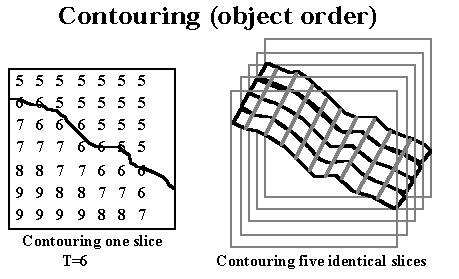
- Assumes Volume Contains Thin Boundary Surfaces
- Classify All Cells as Inside, Outside, or "On" The Surface
- Fit Constant-value Surfaces to All "On" Cells
- Render Surfaces
Surface-fitting Advantages
- Rendering Methods are Known: Shadows, Depth Cueing, Reflections, etc.
- Render in Hardware
- Display List in Memory
- Changing View/Light(s) Requires Only Rendering
- Compact Storage & Transmission
- Render in Object Order or Image Order
- Good Spacial Coherence for Efficient Rendering
Surface-fitting Disadvantages
- Requires Binary Classification
- Throws Away Data Between Surfaces
- False Positives and Negatives
- Handles Small Features Poorly
- Can't Handle Branching
- User Intervention Sometimes Required
- Amorphous Data Doesn't Have "Thin Surfaces"
- 30 Minutes to Extract 500,000 Triangles

 Main Surface Fitting
Algorithm Page
Main Surface Fitting
Algorithm Page
 HyperVis Table
of Contents
HyperVis Table
of Contents
Last modified on February 16, 1999, G.
Scott Owen, owen@siggraph.org