
In this algorithm the user first specifies a threshold value. For this value, some voxels will be entirely inside or outside the corresponding isosurface and some voxels will be intersected by the isosurface. In the first pass of the algorithm the voxels that are intersected by the threshold value are identified. In the second pass these voxels are examined and a set of one or more polygons is produced, which are then output for rendering. Each of the voxel's 8 vertices can be either inside or outside of the isosurface value, thus, there are 2^8 = 256 possible ways in which a surface can intersect the voxel. By symmetry these 256 ways can be reduced to 15. The exact edge intersection points are determined and the polygons are created. Use a Table Lookup to Reduce Edge Intersection Tests
Basic Idea
256 Cases Reduce to 15

Marching Cubes Algorithm
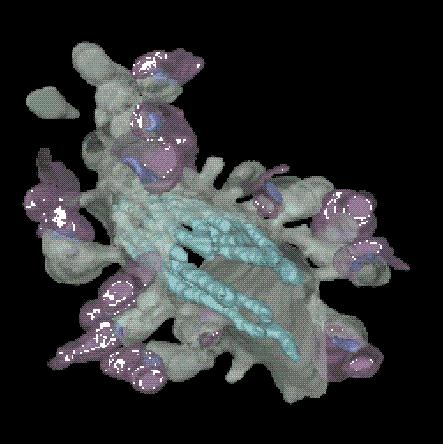
Purkinje cell (Martone & Hessler)

 Main Surface Fitting
Algorithm Page
Main Surface Fitting
Algorithm Page
 HyperVis Table
of Contents
HyperVis Table
of Contents