Dividing Cubes
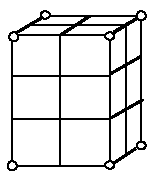
This is similar to the Marching Cubes algorithm except that when a voxel is determined
to be intersected by the isosurface, it is projected to the image plane. If it projects to
a single pixel or smaller, than it is just rendered as a point, else it is subdivided into
surfaces as with the Marching Cubes algorithm.
Basic Idea:
- Create "Surface Points" Instead of Triangles
- Associate Surface Normal with Each Surface
- Point Surface Points, When Rendered, Are Pixel Size
- Subdivide Cells as Necessary
Subdivide Cells as Necessary
- Eliminates Scan Conversion Step
- Point Cloud Rendering Randomly Ordered Points
- No Topology
Dividing Cubes Algorithm
- User Specifies Threshold Value
- Read Four Slices Into Memory
- Compute Gradients
- Divide Cells Into AxBxC Cubes. Resample
- Test for Surface Intersections
- Interpolate Gradient Vectors Where Needed
- Shade Cube
- Rotate/Project Each Cube & Paint Pixel

 Main Surface Fitting
Algorithm Page
Main Surface Fitting
Algorithm Page
 HyperVis Table
of Contents
HyperVis Table
of Contents
Last modified on February 16, 1999,
G. Scott Owen, owen@siggraph.org