Framework of a Visualization System
Reference Chapter 2, [Brod92]
Introduction
Definition:
Outside of computer graphics, two standard defintions of visualization are as follows:
- making visible, especially to one's mind (thing not visible to the eye) [OED69]
- forming a mental image of something (thing not present to the sight, an abstraction,
etc.) [WEB70]
Within computer graphics the term scientific visualization is defined more
specifically, e.g., as follows:
- the use of computer imaging technology as a tool for comprehending data obtained by
simulation or physical measurement [Haber90]
- techniques that allow scientists and engineers to extract knowledge from the results of
simulations and computations [Niel90]
To produce a framework for visualization systems, the definition and scope must be
described. Then the framework is developed in terms of a sequence of models.
Scope
To fully describe the process of scientific visualization as being one that provides
insight, the complete cycle of acessing, processing, and display of data needs to be
addressed.
High Level Models
Creative Thinking
There are four stages in creative thinking: Preparation, Incubation, Illumination, and
Verification. Data Visualization systems assist in Preparation (using a Data Visualization
system for data "brain storming") and Verification (using a Data Visualization
system to verify a tentative hypothesis about the data).
Scientific Investigation
The following model of scientific investigation has been proposed:
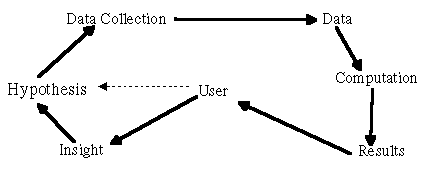
The investigator uses insight to formulate a hypothesis, collect data, build a model,
compute a simulation, view and interpret the data, and iterate.
Other Considerations
- Data accuracy and errors: The system must be able to handle data accuracy and errors.
Some of these may be artifacts of the experimental data and some may be artifacts of the
visualization process. It is extremely important to guard against errors introduced by the
visualization system.
- Annotation: The system must allow the users to annotate the images and animations.
- Distributed Architecture: The visualization system may be part of a distributed system,
e.g., a workstation on a network with other workstations and/or supercomputers. Some of
the system modules may execute on other machines.
- Responsiveness: The response time of the system must be such as to prevent user
impatience and disgust. For complex data sets and images certain tradeoffs may have to be
made with current technology. For example, a crudely shaded image might be show quickly
and then later the user can request a high quality image.
- Human-Computer Interface: These involve cognitive and perceptual issues.

 HyperVis Table of
Contents
HyperVis Table of
Contents
Last modified on April 05, 1999, G.
Scott Owen, owen@siggraph.org