

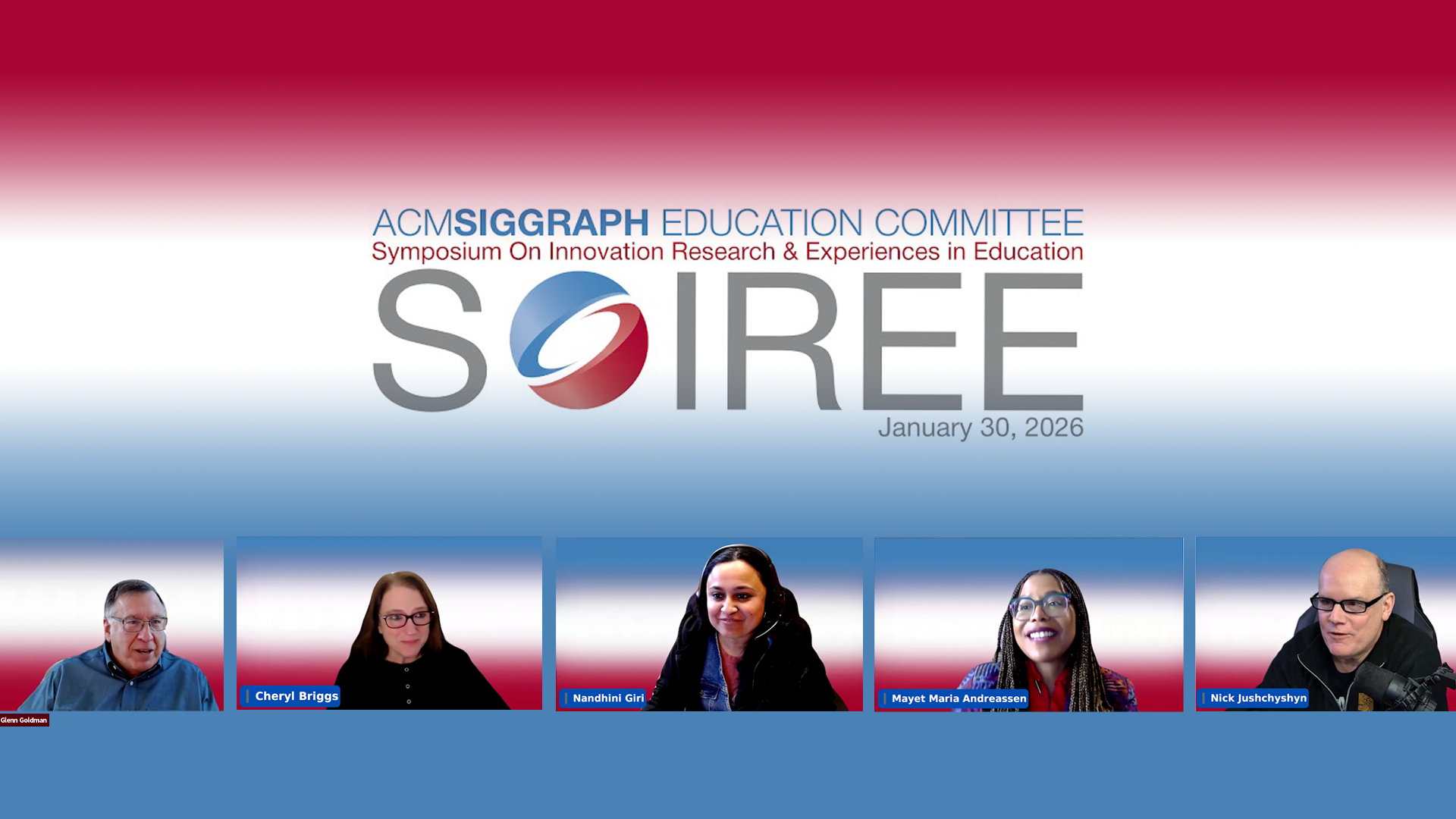
The 2026 ACM SIGGRAPH Education Committee’s Symposium On Innovation Research & Experiences in Education (SOIREE)
Sessions:
- Welcome & Blind Contour: Integrating Art, Robotics and Performance
- Novel Approaches and Projects for Curricular Development
- Adapting and Integrating Developing Tech into Curricular Experiences
- Realtime Graphics for Storytelling and Engagement
- Influencer Professors?: Leveraging Video-Sharing For Student Benefit
- Expanding Embodiment and Agency through Motion Capture and AI
- Creating Novel Technology-based Experiences in the Studio
- SIGGRAPH 2026 Opportunities
- Cultivating Unique and Creative Learning Experiences
- Future Focused Curricular Designs in Computer Graphics and Interaction
Welcome & 1: Blind Contour: Integrating Art, Robotics and Performance
Welcome to the 5th annual Soiree Symposium on Innovation, Research, and Experiences in Education hosted by the SIGGRAPH Education Committee.
Welcome and Introduction featuring:
- Glenn Goldman – New Jersey Institute of Technology, USA, SIGGRAPH EDU Committee Chair
- Nick Jushchyshyn – Drexel University, USA, Master of Ceremonies
The SIGGRAPH Education Committee kicked off the 2026 SOIREE with a warm welcome from Chair Glenn Goldman and event organizer Nick Jushchyshyn.
Session 1: Blind Contour: Integrating Art, Robotics and Performance
Presented by:
- Johannes DeYoung – Carnegie Mellon University
- Peter Schaldenbrand – Carnegie Mellon University
This opening session explores the intersection of art, robotics, and embodied performance through the Blind Contour project. By combining choreographic movement, machine learning, and robotic systems, the work investigates how human gestures can drive generative visual, auditory, and haptic outputs. The session sets the stage for SOIREE 2026 by highlighting interdisciplinary experimentation and new forms of creative expression emerging at the convergence of technology and performance.
Session 2: Novel Approaches and Projects for Curricular Development
Presentations:
- Doctor Post-Processing: Or How They Started Engaging and Love the Convolution
- Samuel Silva – University of Aveiro, Portugal
- Animating the Landscape: A Service Learning Collab
- Damian Thorn-Hauswirth – East Stroudsburg University, PA, USA
- Beyond the obvious – Instilling fundamental CG knowledge and workflows through VFX camera acquisition
- Rehan Zia – National Centre for Computer Animation (NCCA), Bournemouth University, U.K.
This session focuses on innovative strategies for curriculum design in computer graphics education. Presenters share approaches that increase student engagement by connecting foundational concepts to real-world applications, including service-learning animation projects, game engine-based image processing workflows, and production-oriented VFX camera training. Together, these projects demonstrate how aligning coursework with industry practices and meaningful contexts can deepen learning and improve student outcomes.
Session 3: Adapting and Integrating Developing Tech into Curricular Experiences
Presentations:
- Beyond Traditional Interfaces: Teaching XR and Multimodal Interaction at the Doctoral Level
- Bernardo Marques – University of Aveiro, Portugal
- From Complexity to Clarity: Rethinking Rubrics for Iterative, Industry-Aligned Learning
- Cheryl Briggs – University of Central Florida, USA
- Teaching AR through Branded Moments
- William Truran – University of Central Florida, USA
This session explores how emerging technologies are being integrated into contemporary curricula. Topics include XR and multimodal interaction design at the doctoral level, streamlined rubric systems that emphasize iterative learning and professional alignment, and augmented reality experiences grounded in real-world branded applications. The session highlights how educators are balancing innovation with clarity, ensuring that new technologies enhance, and not overwhelm, the learning process.
Session 4: Realtime Graphics for Storytelling and Engagement
Presentations:
- Exploring Gen-AI Tools in a Virtual Production Pipeline
- Topher Maraffi – North Carolina State University, USA
- Assessing Understanding in the Age of Artificial Generation
- Michael G Wagner – Drexel University, USA
Focusing on the impact of generative AI, this session examines how educators are adapting both classroom practices and assessment strategies. Presentations address the integration of AI tools in virtual production pipelines and the challenge of evaluating authentic student understanding in an era where AI can generate polished outputs. The discussion emphasizes process-based assessment, critical thinking, and maintaining academic rigor in rapidly evolving technological landscapes.
Session 5: Influencer Professors?: Leveraging Video-Sharing For Student Benefit
Presented by:
- Monica Cappiello – University of California, Los Angeles, USA
- Shaun Foster – Ohlone College, USA
- Nick Jushchyshyn – Drexel University, USA
This session examines how educators are using video-sharing platforms to extend learning beyond the classroom. Through collaborative insights from multiple institutions, presenters discuss strategies for leveraging online content to enhance student engagement, build professional visibility, and create accessible learning resources. The session highlights both the opportunities and challenges of integrating public-facing media into academic practice.
Session 6: Expanding Embodiment and Agency through Motion Capture and AI
Presentations:
- One Body, Four Minds: Virtual Multi-person Co-embodiment in a Shared 3D Body
- Rochele Gloor – School of Visual Arts, USA
- Animating the Fool: Democratizing Authentic Character Movement through AI-Driven Motion Capture
- Richard Thompson – New Jersey Institute of Technology, USA
This session explores innovative approaches to motion capture and embodied interaction. Presentations include shared-avatar systems that enable multiple participants to control a single digital body and performance methodologies that incorporate theatrical traditions such as clowning to enhance emotional clarity in animation. Together, these works expand access to motion capture technologies while deepening expressive possibilities in character performance and digital embodiment.
Session 7: Creating Novel Technology-based Experiences in the Studio
Presentations:
- Light Field Cinematography (And the Birth of a Volumetrics Lab)
- Kaia Olsen – University of Iowa, USA
- Creating an Educational LED Wall Studio
- Nick Jushchyshyn – Drexel University, USA
This session highlights cutting-edge studio-based production and research initiatives. Topics include volumetric capture and light field cinematography workflows, as well as the development of accessible LED wall environments for virtual production.
Session 8: SIGGRAPH 2026 Opportunities
Presented by:
- Nick Jushchyshyn – Drexel University, USA
This session provides an overview of opportunities within the SIGGRAPH Education Committee and a preview of SIGGRAPH 2026. Presenters highlight ways for educators to engage with the community through submissions, collaborations, and year-round initiatives. The session emphasizes the importance of participation, knowledge sharing, and continued innovation within the global SIGGRAPH education network.
Session 9: Cultivating Unique and Creative Learning Experiences
Presentations:
- The Importance of Gum
- Barbara Mones – University of Washington, Seattle, USA
- DecWar – Collaboration across coding, installation, creative, and archival teams to revive a historic game and timeless vibe.
- MK Haley – University of Texas, Austin, USA
- Empowering Students through Real-Time Animation: A Work-Integrated Learning Approach to Sustainability
- Melody Li – University of New South Wales, Australia
This session focuses on creative, collaborative, and experiential learning models. Presentations range from effects-driven animation projects inspired by real-world cultural artifacts to interdisciplinary collaborations reviving historic digital experiences and sustainability-focused animation pipelines. The session underscores the value of teamwork, creativity, and real-world context in preparing students for industry and research environments.
Session 10: Future Focused Curricular Designs in Computer Graphics and Interaction
Presentations:
- Integrating 3D Gaussian Splatting into Creative Media Curricula: Strategies and Challenges
- Lukasz Mirocha – Opus Lab / City University of Hong Kong, China
- Adapting Pedagogy for Emerging Contexts: An Accessible Node-Based Learning Pathway for First-Year Undergraduate Students in Vietnam
- Patrick Hartono – RMIT University Vietnam, School of Communication and Design
- AI as Co-Pilot: Teaching Architecture Through Dialogue with Generative Systems
- Taro Narahara – New Jersey Institute of Technology, USA
The final session looks ahead to the future of computer graphics education. Presenters explore emerging technologies such as Gaussian splatting, AI-assisted design workflows, and accessible node-based learning systems for diverse global contexts. Emphasis is placed on adaptability, inclusivity, and preparing students for rapidly evolving creative and technical landscapes.