|
|
Video Technologies in Use by
Consumer CD-ROM Titles:
A survey
Darren Giles, Terran Interactive
August, 1997
There are many technologies to choose from when producing video for a CD-ROM title. Each
has unique strengths and weaknesses, and there is no one choice which is right for every
application. However, I thought it would be informative to better understand the choices
which have been made for the existing selection of CD-ROM titles.
To that end, I organized a survey of existing CD-ROM titles for sale at a major consumer
electronics outlet. It is important to point out that this is not a scientifically rigorous
study. Nonetheless, the information gleaned provides some interesting insights.
Methodology
As the goal was to study the titles currently in the marketplace, we went directly to the
shelves of our local Fry's Electronics (one of the biggest computer hardware/software chains
in the Silicon Valley).
Out of several hundred CD-ROM titles, we focused on those which contained digital video (a
high percentage). Of those, we selected 54 titles at random. They included game, education,
and business titles. Several were old classics that are still going strong (like Myst);
many were the latest releases.
We then examined the packaging to determine three things:
- architecture used (QuickTime, MPEG, etc.)
- supported operating systems (MacOS, Windows)
- system requirements
In the instances where the packaging was unclear, we visited the web site and/or contacted
the publisher.
Multimedia Architectures
As we're fond of saying, "the great thing about standards is that there are so many to
choose from." The titles we examined included nearly all of the popular architectures.
The chart below shows the number of titles using each architecture; I'll elaborate on each
in order of popularity.
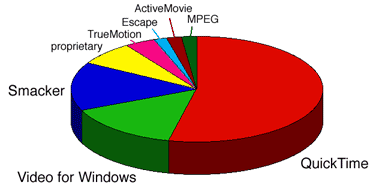
QuickTime is by far the dominant architecture for consumer CD-ROM, with more than 50%
of the titles. In the six years since its first release, QuickTime has continued to lead in
several critical areas, including cross-platform delivery, ease of development, and a wide
range of codecs and media types.
Video for Windows, often called the "AVI format," has been discontinued by
Microsoft for about a year. It has several weaknesses, including a lack of MacOS support,
and audio sync problems. However, a fair number of titles use this technology for one
primary reason: playback support is built into Windows.
Smacker is a proprietary architecture which focuses on the low end of the marketplace:
486's with 8-bit video. Its popularity illustrates the need in the marketplace for a good
low-end story. As shown below, 486's have a very significant influence on the consumer
market, and 8-bit video displays are shockingly common.
Proprietary architectures offer developers the ultimate flexibility and
controllability, since they design and write it themselves. The downside of this route is
the very substantial amount of programming required to replicate even part of the
functionality of existing architectures. Proprietary video architectures are mainly used
by very large developers, such as LucasArts.
The Duck Corporation's TrueMotion technology is aimed at high-quality, high-end
playback. Special features include "comprending," which allows multiple video
clips to be superimposed. The TrueMotion codecs will also be available as part of
DirectShow.
DirectShow and ActiveMovie are Microsoft's replacements for Video for Windows. Both
of these technologies are quite new; DirectShow hasn't been around long enough for titles
using it to reach the shelves yet. Also, the lack of MacOS support has hampered acceptance.
Eidos Technologies' Escape technology provides a number of advanced features, as well
as high image quality. It is used on the Eidos title "Tomb Raiders," as well as
a small number of other publishers' titles. Escape is now available for QuickTime as well.
Click here for more information on Escape.
MPEG often seems as if it's the holy grail of digital video. Why, then, is it
nearly impossible to find consumer titles which use it? The main reason is the high
requirements for playback hardware (either dedicated MPEG cards or high-end Pentiums).
There are also some sticky licensing issues.
Supported Operating Systems
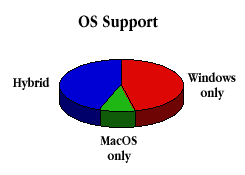
Consumer titles cannot easily ignore the huge marketshare enjoyed by Windows: 91% of titles
will run on a Wintel machine, and 46% are Windows-only.
It's relevant to point out that 54% of titles will run on MacOS. There are several studies
which suggest that MacOS titles are more sucessful than might be expected from MacOS
marketshare. Reasons given include lower support costs, higher buying percentage, etc.
However, MacOS-only titles are quite rare (9%).
The ideal solution is a hybrid which will run on both platforms. 44% of the titles examined
fell into this category. Developing a hybrid requires the use of technologies which work
well on multiple platforms. It also requires rigorous cross-platform testing during
development, a step which is often ignored until late in the process.
System Requirements
The minimum required platform defines which technologies are available to you, and what you
can expect of your runtime environment. The initial tendency is to say "Well,
everyone's got at least a Pentium 133 these days." Don't count on it... most title
developers look back 2-4 years. The survey turned up some interesting stats for recommended
CPUs:
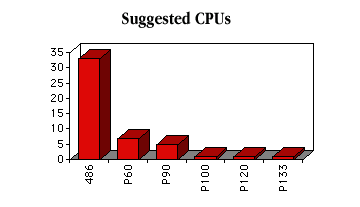
Admittedly, you can expect the base systems to get faster over time, and a title released
next year will encounter a different mix of systems. But it's been a while since the 486
reigned, and it's still got a strong impact on development. If you're going to require a
Pentium, think twice before requiring a P166!
Conclusions
There is a strong trend towards conservatism in consumer titles. This largely reflects
market realities; the goal of a consumer title is to provide the largest number of consumers
with the best possible experience. (Okay, it would be more correct to say the goal is
"to make a lot of money." But that's how you get there.)
I'm the last person to advocate blindly following precedent. But hopefully understanding
the trends will allow you to make a better decision in bucking or following them.

Darren Giles
Technical Director
Terran Interactive, Inc.
|

